Showing posts with label Race. Show all posts

06 January 2016

The Spectre of Nativism

Few things get my historical scholar's goat more than a post like this one, about Trump the Nativist.

Nativism was a complex phenomenon throughout American history, and a very mutable one. In this case, I would like to look at what might be considered a Janus-faced component of the old-time Nativist like George Bourne, whose Abolitionist views were inseperable from those attitudes he shared with Trump. Let's take a closer look at Robin Dale Jacobson's commentary.

While many pundits have looked to former regimes in Germany or Italy to explain the dangers they perceive Trump to embody, we need to understand him and his following as an American phenomenon. . . . John Higham, in the canonical book Strangers in the Land, wrote that nativism is “an intense opposition to an internal minority on the ground of its foreign (i.e. ‘un-American’) connections.” This opposition can have a wide range of targets in “response to the changing character of the minority irritants and the shifting conditions of the day; but through each separate hostility runs the connecting, energizing force of modern nationalism.”

Certainly American Nativism is rooted in the idea of nationality. The problem is that nationality is another of those mutable ideas that in a political discourse conceals much more than it reveals. What is the basis for a nation? The first naturalisation act, passed in 1790, defined a potential new American as a 'free white person'. It then asked them to live in the country for two years. It is this residency period that is of interest here, and is a commonplace in naturalisation legislation around the world even today. The final step in the process was to swear an oath of allegiance to support the Constitution. Today's historians focus on the whiteness requirement, but at the time that was barely discussed. In fact, it certainly seems that the residency requirement was seen as crucial.

Mr Hartley said...he thought some security for their fidelity and allegiance was requisite besides the bare oath that is, he thought an actual residence of such a length of time as would give a man an opportunity of esteeming the Government from knowing its intrinsic value, was essentially necessary to assure us of a man's becoming a good citizen.

from the House Journal, 1st Congress, pp 1147-8

Thus, from the very first piece of federal legislation concerning immigrants, we see that there are important political considerations involved in the question of nationality. The key element turns out to have been the residency requirement, as opposed to the 'bare oath' This is further illustrated by later debates on the 1798 act that sought to extend the residency period to fourteen years.

Mr Bayard said...Every principle of policy, in his opinion, required this regulation to be made general; for he believed there was many Jacobins and vagabonds come into the United States during the last two years, as may come for ten years hence; so that these very persons against whom this law was intended to operate, will become citizens, and may be chosen into the government.

from the House Journal, 5th Congress, p 1780

Again, here we see a political issue. At the time of the French Revolution, Jacobins were seen as having the potential to subvert the Constitution, given their unhealthy enthusiasm for the will of the people, as opposed to the kind of solid bourgeois republicanism that defined the American. But it was also the moment of the Quasi-War, which could easily have turned into a proper one.

Mr Varnum said...there was no necessity for any measures being taken with respect to foreigners, except such as belong to the nation with whom we expect to be at war.

from the House Journal, 5th Congress, p1782

I can easily imagine how a Trump supporter might see the United States as a nation at war with Islam, or at least those of its Radicals who have in practical terms declared war on it. The fact that a significant majority of Americans polled are opposed to a ban on Moslem visitors should give us some comfort. Let me return to Jacobson's text.

The durable American nativist tradition has an additional common feature: a racial religious othering. Throughout history we see religious differences being blended with racial differences; groups of people perceived to be sharing a religion are characterized as having innate immutable differences that threaten the native citizens or the nation as a whole. ... Nativist responses to new immigrants from southern and eastern Europe in the early twentieth century were also centered at the intersection of race and religion. Advocates who opposed immigration argued that these newcomers from sending areas in Europe, including Italian and Irish Catholics as well as eastern European Jews, threatened to overwhelm the U.S., and to damage the racial and religious character (read: white, Anglo-Saxon Protestant) of the country.

Here Jacobson is guilty of condensing two distinct moments in Nativism. In the 1830s through the 1850s, hostility towards immigrants was mostly rooted in their Catholicism. The hostility that emerged in the 1890s and carried on into the quotas of the 1924 immigration legislation did identify nationality or, if one prefers, ethnicity in relation to religious hostility. Tellingly, this covers the period that Higham does. He gives only a few pages over to the earlier manifestations of Nativism, and does not reflect at length on the process by which ethnicity became attached. But I would like to focus on the earlier response. Why did Roman Catholicism seem to present a threat?

This shameful font of indifferentism gives rise to that absurd and erroneous proposition which claims that liberty of conscience must be maintained for everyone. It spreads ruin in sacred and civil affairs, though some repeat over and over again with the greatest impudence that some advantage accrues to religion from it.

Para 14 of the Papal Encyclical Mirari Vos, issued in August 1832

Here We must include that harmful and never sufficiently denounced freedom to publish any writings whatever and disseminate them to the people, which some dare to demand and promote with so great a clamor. We are horrified to see what monstrous doctrines and prodigious errors are disseminated far and wide in countless books, pamphlets, and other writings which, though small in weight, are very great in malice.

Para 15 of the Papal Encyclical Mirari Vos, issued in August 1832

These two paragraphs suggest that 1830s Americans had cause to be suspicious about the threat posed by the Roman church to proverbially American values enshrined in the Bill of Rights. Nor were Americans shy about taking these comments aimed at liberty of conscience and freedom of speech and expanding them to encompass much more.

Romanism, in its merely secular attributes and political and social effects, ever and immutably is opposed to civil and religious freedom; and is destructive of all those rights of man with which our Declaration of Independence proclaims to be inalienable.

p6, The Text-Book of American Popery, George Bourne's Nativist book

And, of course, as immigration from Catholic countries grew, it was associated with this political threat to the American political order.

This danger from uneducated mind is augmenting daily by the rapid influx of foreign emigrants, the greater part unacquainted with our institutions, unaccustomed to self-government, inaccessible to education and easily accessible to prepossession, and inveterate credulity, and intrigue, and easily embodied and wielded by sinister design. In the beginning this eruption of revolutionary Europe was not anticipated, and we opened our doors wide to the influx and naturalisation of foreigners. But it is becoming a terrific inundation...what if this emigration, self-moved and slow in the beginning, is now rolling its broad tide at the bidding of the powers of Europe hostile to free institutions, and associated in holy alliance to arrest and put them down?...Are not the continental powers alarmed at the march of liberal opinions, and associated to put them down?

pp 51-2, Foreign Conspiracy Against the Liberties of the United States, by Samuel Morse (unlike Bourne, a defender of slavery).

Morse chooses his words with care there, as the 'holy alliance' was indeed a real thing, lasting from about 1815 to 1820. And the Papacy was seen as in league with the Austrian Empire, itself in the care of Prince Klemens von Metternich, a particular bogeyman of those 1830s Nativists, as can be demonstrated by a citation from this 1836 article.

Austria is now the only temporal support of the Papal power in Europe. Under the ministry of the most tyrannical Prince Metternich, she continues her support to the Court of Rome. This Prince Metternich is one of the greatest enemies of mankind now living; a man who has done more for the support of despotic principle, and to enslave the masses of Europe, than any other man.

p178, Methodist Magazine, April 1837, from an article on the Papacy's prospects by a New England divine named S W Coggeshall who was possibly the author of this letter to Lincoln supporting a more radical approach to war against the Confederacy.

Those masses fleeing Metternich's slavery, however, showed little sign of embracing Protestant religion, despite spending several years breathing liberty's air in the United States. Instead, they were building up a Catholic presence in the United States, which people like Bourne, Morse and Coggeshall thought clearly alien to American political values. While Coggeshall mentions Irish immigration, it is only a reference to its scale (see p 180). His invective says nothing about race but everything of his fears of Catholic institutions being founded in the United States, and the conspiratorial efforts of a mysterious St Leopold Foundation, directed from Vienna and in receipt of papal approbation.

Whatever changes might arise for historians to argue over in its later manifestations, history shows us that the man concern Americans initially had about immigrants related to their politics. In this case, the internal minority was a religious one and, further to remove race from the equation, one that drew its membership from multiple states, and thus possessed loyalty (or antipathy, in the case of the Irish) towards different regimes that might, in fact, find themselves at war with one another.

It is without question that American Nativism was from the first about protecting more than the political character of the United States, and that initially race was a less significant factor since not many sought to emigrate here willingly from Africa or Asia. Slavery was, however, seen as a blot on the principles enunciated in the Declaration of Independence by many Americans. It was Lincoln himself who put forth that the civil war was 'testing whether that nation, or any nation so conceived [in Liberty] and so dedicated, can long endure'. For Americans of his time and the few decades earlier, American liberty seemed a precariously planted tree in a world where monarchs ruled China, India, Russia, Prussia, Austria, Brazil, Turkey, Persia, Morocco, Zululand and Madagascar. Those ideas of liberty were rooted in an Anglo-Saxon, Protestant outlook that was a smaller set than the word 'white' might imply in naturalisation acts passed by Congress. It was this day-to-day 'Anglo' culture that was seen as defining Americans. To reduce these fears to race alone does a disservice to that generation of abolitionists, unsympathetic toward 'papist' religion, who fought more successfully to end race-based slavery.

(P.S. -- By the way, if you didn't follow the Wikipedia link, George Bourne, abolitionist and nativist, was himself an immigrant from England.)

23 June 2014

A G.I. Bride

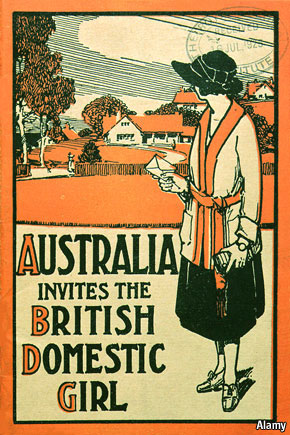
My mother was a GI Bride. It probably is the act that most defined her life, a life which illustrates the effects of historical processes on 'little people', those whose absence from archives makes comprehending the past so difficult for historians. The briefest summary of her life shows how none of us can live free of the past, no matter how much we might think it is possible.

She was born in Portsmouth, on England's south coast, in 1927. The year and place establish that she would be exposed to two of the most critical events of the twentieth century, the Great Depression and the Second World War. But being born in England meant that she would be among the relatively privileged of the world, even if her parents were not among the elite of English society. She had the opportunities of a better education, better health care and access to the earning potential of work in one of the world's most advanced economies. The reasons why Britain could make all this available to her rested on the course of events over some three hundred years of history, from the reign of Charles I until my mother's own time. During this, Britain had risen from a Western European power into the greatest of Great Powers, with an empire that encompassed all of South Asia, much of Africa and included a degree of economic dominance of the South American economy. This power and wealth provided a job to her father, who made a career serving in the Royal Navy, that insulated the family to some extent from the effects of the Great Depression.

Her life would be changed utterly by the Second World War, like so many. She was very bitter about this, although would rarely talk about it. Once she commented that the Germans had robbed her of her adolescence, which itself was a concept that really only took shape for people of her social situation in the aftermath of the First World War. By the time of the war she was living in Fareham, a town along the Solent coast between Portsmouth and Southampton. There was some bombing of Fareham, although it was not 'blitzed' as heavily as Portsmouth. It seems she was bright enough to attend some kind of tertiary education, but the patriarchal mentality of that time meant that she left school at sixteen and went to work as a kind of office dogsbody in a Southampton hotel. It was in Southampton that she met he future husband, a G.I. who worked at the hospital at Netley. The war itself made possible this meeting.

After the war, she crossed the Atlantic aboard the Queen Mary to live with her husband in Detroit, Michigan. We rarely think of the Second World War as a time of great migrations, but displaced persons and G.I. or wartime Brides were part of a notable transference of people from one part of the world to another. The United States made special legislation, the War Brides Act, to cope with this situation. In Detroit, she found an industrial city that had continued its tremendous twentieth-century expansion during the war. Younger people today may have difficulty in understanding just how well-off one could be living in Detroit after the Second World War. Union jobs in factories associated with the car industry made the workers of Detroit enviable — if they had seniority. They could afford houses, cars and appliances that their parents could only have dreamt of during the straitened days of the Depression. Layoffs and long-term strikes, however, created difficult times, and contributed to my mother's tremendous sense of thrift. By the 1960s, however, my father had built up sufficient seniority that we were eventually able to afford a trip to England, during which my mother met her parents again for the first time since 1945, almost twenty-five years.

My mother was disturbed by the notorious racial tension in Detroit. She always expressed antipathy towards the very notion of 'white flight'. She also had a few telling observations about how jobs at J.L Hudson's downtown department store were segregated. There was little that an individual could do in the face of institutional prejudice except to treat the people one met on their merits. She did, however, believe strongly in education as the means by which people should equip themselves to overcome any disadvantages, and that meant a degree of assimilation to the dominant social mores. The 1950s and 1960s were the final years of the WASP Ascendancy, that time from the Gilded Age until 'The Sixties' during which the American elite was a caste rooted in the northeast who lived somewhat as 'offshore Europeans', aping either the luxuries of the pre-Revolutionary French aristocracy or the lifestyle of a British landed gentry. She raised her children to use this caste as a yardstick.

Her children all succeeded in the tertiary education that she missed out on. They benefited from the expansion of higher education that resulted in part from the G.I. Bill, but also from other Federal government initiatives that ensured students from humble backgrounds could acquire higher education without putting themselves into severe debt. I would think that this was the achievement of which she was most proud, because it would not have been possible without her help in making us self-disciplined, literary and mathematical. Nonetheless, it would not have been possible without a social policy that sought to ensure that capable students could benefit from inexpensive higher education. Currently, the Anglosphere drifts towards a system of higher education that burdens young people with debts while being stingy in the supply of good-paying jobs to equip the students to pay off those debts.

During the early 1980s, my mother returned to England for a time and lived in London. However, the birth of her eldest grandchild in 1983 transformed a temporary visit into a permanent one. In this she finally experienced the suburbanisation of America, as her Detroit home that she finally left in 1980 was within the city limits of Detroit. Subsequent to 1983 she lived in low-density neighbourhoods in the suburbs of Columbus, Ohio, in the city of Davenport, Iowa, and in the area of Kalamazoo, Michigan. This urban sprawl produced unprepossesing strip malls and big-box stores, while housing tended to be inaccessible by public transport (although not in the case of Davenport, where she lived by a bus stop). She never learned to drive, so in the absence of buses she was reliant on my brother to travel .

At the end, medical and pharmaceutical technology ensured my mother outlived her own mother by about four years. She suffered from colon cancer a few years ago, which was successfully treated, but a mystifying incident in the autumn of 2012, when she had a faint, took a heavier toll on her health. She wasn't quite housebound after that, but her mobility was sharply restricted as she became too weak to walk for too long. Tumours began to squeeze her œsophagus shut in the winter of this year, although a cough that seems to have been associated with lung cancer suggests trouble there, too. In May she decided she only wished to undergo palliative care, and lived out her life in a hospice until she died in the early hours of 20 June, last Friday. Despite having lived in the United States for almost her entire adult life, she remained British in her official citizenship, never having taken out American nationality. However, having been offered the chance to have her remains transported home, she declined. As the wife of a veteran, she was allowed to be interred in a nearby military cemetery. The last act of her life remained literally linked to the title of this post.

The point of this very long blog entry is to illustrate how a single life can be used to structure a history course. Simply by highlighting these broad historical themes, one can see how our lives are not matters of individual choice, but are subject to historical conditions over which we have no control, starting at the very moment of birth. Think of a eleven-week course constructed around this life, including some topics I haven't covered in this little essay:

1) Britain's empire in the twentieth century.

2) The Great Depression

3) The Second World War

4) Migration in Britain and the United States

5) Racism and the Urban Question

6) From urban to suburban in North America

7) The rise and fall of mass tertiary education

8) Women's role in peace and war, 1930 to 2010

9) 'Live Long and Prosper': medicine during the Postwar Era

10) From cinema to downloads, a history of modern entertainments

11) The strange rise and impending decline of the Anglosphere

History at its inception was a narrative art, and largely bounded by large events, just like a human life.

25 February 2014

Babb: "They Gave the Crowd Plenty Fun"

The National Archives has been posting podcasts of its events (really lectures) it holds to its site for some time. The quality of these is mixed. In some cases, the lecturer relies too much on the PowerPoint-style display for what is effectively a radio broadcast. Others are just a description of the contents of various files that might be of interest to researchers. But some are genuinely excellent. In the latter category I place 'They Gave the Crowd Plenty Fun', presented by Colin Babb.
Although this podcast focuses on West Indian cricket, it really is about the immigrant experience, as seen through the perspective of the sports fan. When I did my major field in Race, Imperialism, Slavery, one of the two topics that drew my greatest interest was the relationship between race and immigration. Sometimes immigration has nothing to do with race. Sometimes race has almost everything to do with immigration. Most usually they overlap in ways that it is the historian's job to explain. (The Irishman in the lower-left corner has rather simian features.) It is a fascinating subject, especially if one avoids bringing to it attitudes strongly influenced by today's debate over immigration and sticks closely to the the perspectives of immigrant and host.
Babb's lecture does a good job, for the sensitive listener, of seeing the dilemma confronting the immigrant. In my view, if people could avoid immigrating, they would. People try to identify with collectivities, and can find it hard to leave parental ones behind. Babb describes himself as a 'British-born Caribbean'. Indeed, the very concept of 'the West Indies' makes more sense from Britain than in the Americas. He points out that his parents were, in fact, from different countries, and that it was their presence in Britain that united them. According to Babb, people from Guyana are seen as 'South American' from the perspective of the islanders of the West Indies. When he went back to the Caribbean on childhood holidays, he was treated as somehow not quite West Indian, while in Britain he was certainly seen as a non-Briton, a 'West Indian'.
In fact, if one reads about the history of immigration, talks to immigrants, or actually does a bit of immigrating oneself, one finds such situations commonplace. The immigrant, and more particularly the child of immigrants, is regarded with a degree of 'suspicion' both in the source region and in their host region. It is an awkward role that one is forced into, and is most obviously expressed in those sporting events based on countries.
I don't want to spoil the lecture, because I think it would be worth your while to have a listen, so I won't give away any more of its content. Let's just say that I found the lecture really raised a great deal of sadness in my mind that the legacy of the British Empire may now finally be dying, reflecting the gentle aging into retirement of that 'post-imperial' generation which includes Babb and myself. Also, that it is interesting how the pattern of assimilation of 'West Indians' in Britain reflects Britain's particular history on race. In the 1960s, the 1970s, and into the Thatcher years, and even today, thinking about the British experience of race and racism often seems a sort of caricature of the American one. But Britain's history of race relations is different — pace the late Stuart Hall, less toxic — and the assimilation of the West Indians reflects that. NB — I cut my finger recently, rather badly, harming my abiity to type. Posts will be erratic for a bit.